
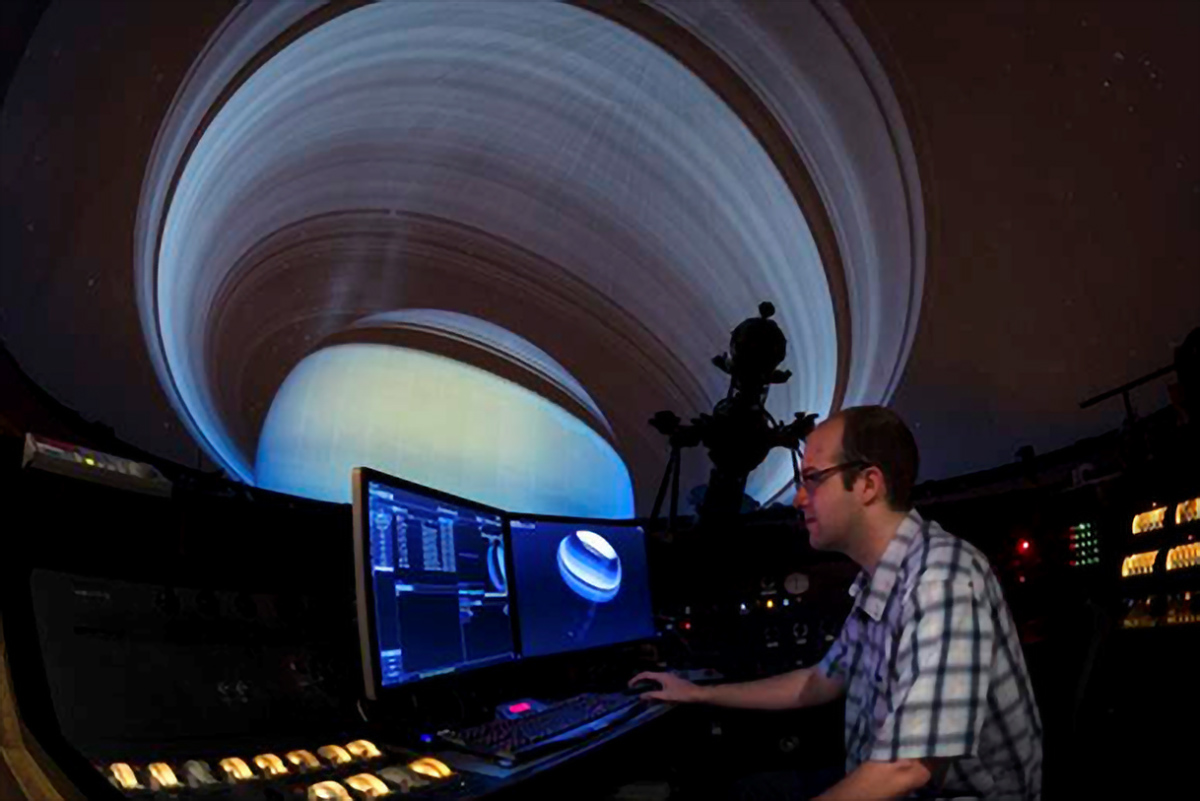
Mike Murray
Delta College Planetarium
Bay City, Michigan
A planetarium is often viewed as an astronomy interpretation and resource center, and includes programming that encompasses a wide variety of disciplines. Achieving the mission of a planetarium requires a staff with specific skills – an astronomy degree alone doesn’t automatically qualify them to be an effective planetarium communicator. Planetarium programs engage audiences on many different levels. The technology is only as good as the people talent making use of it. Here are some examples of activities and skills needed for a successful operation.
For a planetarium to be able to do these things:
- Produce and present engaging programs for a wide variety of audiences.
- Create show content in response to current events and hot topics in science and astronomy.
- Foster and develop community partnerships through outreach.
- Grow connections and provide value to the education community.
- Maintain a healthy offering of special astronomy-related events, in and out of the dome.
- Create quality live-based programming that is engaging and interactive.
- Plan and develop exhibits and interactive displays.
- Make the most of specialized dome theater equipment and develop plans for maintenance and renewal.
- Maintain high standards of performance through continuing education and training.
- Create a development plan for funding new programs, exhibits and upgrades.
- Produce local interest programs, including interdisciplinary subjects, music, theatre, and art.
- Develop working relationships and partnerships with local media, including TV, radio, and online.
- Carry out survey and evaluation instruments that identify the needs and expectations of audiences.
- Collaborate and tap into the collective assets of other planetariums and content producers.
- Provide guidance for students interesting in pursuing careers in space science.
- Be involved with the community and serve as a content specialist for questions asked by media, teachers, students, and the public.
You need dedicated specialists with these kinds of skills:
- Popular science communications – written, verbal, and especially visual (“data storytelling”).
- Ability to adapt content to school curricula and standards.
- Knowledge of show production techniques that are specialized for the dome theater environment.
- Creative team management.
- Research and scriptwriting for visual programs.
- Stay current with the most recent discoveries in astronomy, astrophysics, and space exploration.
- Ability to seize opportunities in an environment of change and ambiguity.
- Budgeting that accounts for dome theater operations, maintenance, and development.
- Professional expertise to create fundraising goals and objectives, and work with fundraising teams.
- Ability to work with all forms of promotional media – print, radio, television, online.
- Effective public speaking and interaction with a wide variety of ages and backgrounds.
- To show humility and respect for other fields of study and perspectives.
- Technical competence with computer equipment, software, and system scripting.
- Ability to stay modern and effective through networking and professional development.
For more resources on planetarium development, operations and professional development, go to the
International Planetarium Society’s resource page.
GLPA members can join the discussion on this article by visiting the Planetarium Pointers forum.